



How it works
Three steps. Five minutes to your first protected transaction.
Add the IntentGuard RPC
One-time wallet setup. Pick mainnet or Sepolia, click the button, approve in your wallet. ~30 seconds.
Sign normally in your dapp
Use any dapp the way you always do. Once signed, the transaction is held — not yet broadcast, not yet onchain.
Define what must be true
Open the protection app. Set the conditions: expected outflows, inflows, balance changes. If execution matches, the transaction lands. If not, it is dropped.
What it protects against
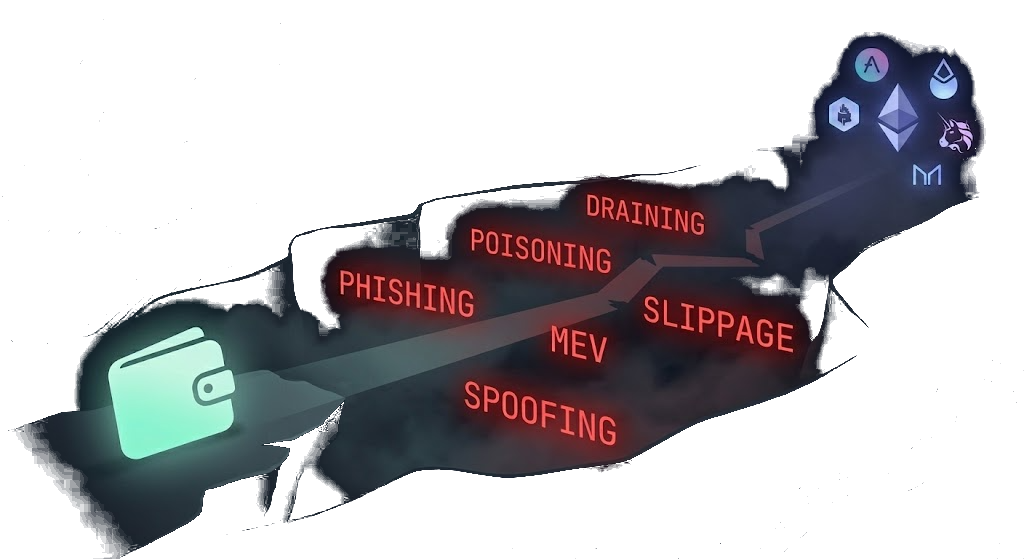
The Execution Gap covers two categories of risk. IntentGuard enforces against both, the same way: if the outcome doesn't match your intent, nothing settles.
Phishing & wallet drainers
Compromised frontends and signature-grabbing dapps swap your recipient or drain approvals at execution time.
Address poisoning
Lookalike addresses dropped into your transaction history get copy-pasted into legitimate transfers.
Malicious dapp behavior
A dapp simulates one outcome at signing time and produces a different one onchain.
MEV & sandwich attacks
Searchers wrap your swap to extract value. You sign for one price, settle at another. Read more →
Slippage beyond your tolerance
Liquidity drift between signing and inclusion produces a worse fill than expected. Read more →
Execution drift
Block-time differences in price, balance, or state push the outcome outside what you intended. Read more →
Built for these teams
One enforcement primitive. Four entry points.
Vault curators
Curate yield without absorbing execution loss.
Start by enforcing your own operational transactions — fee flows, internal rebalances, team treasury. Scale to customer-facing rebalancing once the constraint surface is proven. Cascade losses, MEV extraction, and depositor-visible execution drift, all enforced at the chain level.
Curator guide →Treasury operations
DAOs, foundations, and projects protect every payment.
Payroll, contributor payouts, multisig transfers, grant disbursements. Every transaction settles only if recipient, amount, and outcome match what was signed. Protection applies per transaction. No profile, no onchain registration, free.
Treasury guide →Asset managers
Onchain mandates with institutional-grade integrity.
Declarative execution constraints, atomic enforcement, full audit trails. Compatible with Fireblocks, Fordefi, Ledger Enterprise, and Safe. Built for regulated funds and treasury mandates moving onchain.
Institutional guide →AI agents
Cryptographic guardrails prompt injection cannot bypass.
Agents declare intent through signed constraints. The chain enforces compliance. MCP-compatible. Drops cleanly into MetaMask Delegation (ERC-7710/7715), CoinFello, and other agentic-execution stacks.
AI agents guide →Measure your Execution Gap
Before you enforce, see what you're losing. The Execution Gap Analysis Tool quantifies the difference between what your transactions intended and what actually settled.
Point the tool at any wallet, vault, or treasury. It analyzes recent onchain activity and reports the cumulative gap between expected outcomes at signing time and realized outcomes at settlement. Quantified per transaction, summed across the period.
- ▸MEV extraction across swaps and rebalances.
- ▸Cumulative slippage drift on multi-step operations.
- ▸Outcome divergence on calls that simulated cleanly but settled differently.
The tool is free. No RPC change required. Read-only onchain analysis.
Two paths, one protocol
Founders adopt IntentGuard for their own treasury first. Then ship it to their users.
Protect your own transactions
Add the RPC to your wallet, sign normally, attach conditions per transaction. No profile, no onchain registration, no fee from us.
Read the user guide →Integrate into your wallet or dapp
Same enforcement primitive, exposed through an SDK. Wallets and dapps can offer protected execution to every user without changes to the signing flow.
Read the integration guide →Recent incidents we would have prevented
Real onchain losses where the signed transaction executed exactly as written, but produced a catastrophic outcome.
Phishing made Bybit sign a different transaction than what they saw.
Bybit's signers reviewed a routine Safe transaction onscreen. The bytes routed to their hardware wallet were different — a delegateCall that upgraded the multisig's implementation contract and transferred custody to the attacker. The largest crypto theft on record — a gap between what was reviewed and what was signed. A Protection Transaction declaring expected balance changes and no contract-state mutations rejects this class of malicious upgrade at the constraint layer.
Swapping $50.4M USDT for $36K worth of AAVE
A treasury operator signed a swap, the transaction executed exactly as instructed, and the wallet received tokens worth a fraction of the input. The Execution Gap, in one transaction.
Start protecting your treasury today.
Setup takes 5 minutes. Add the RPC. Sign normally. Define your conditions.
If the outcome doesn't match, nothing settles.